The USWNT Needed Spain More Than It Needed a Win
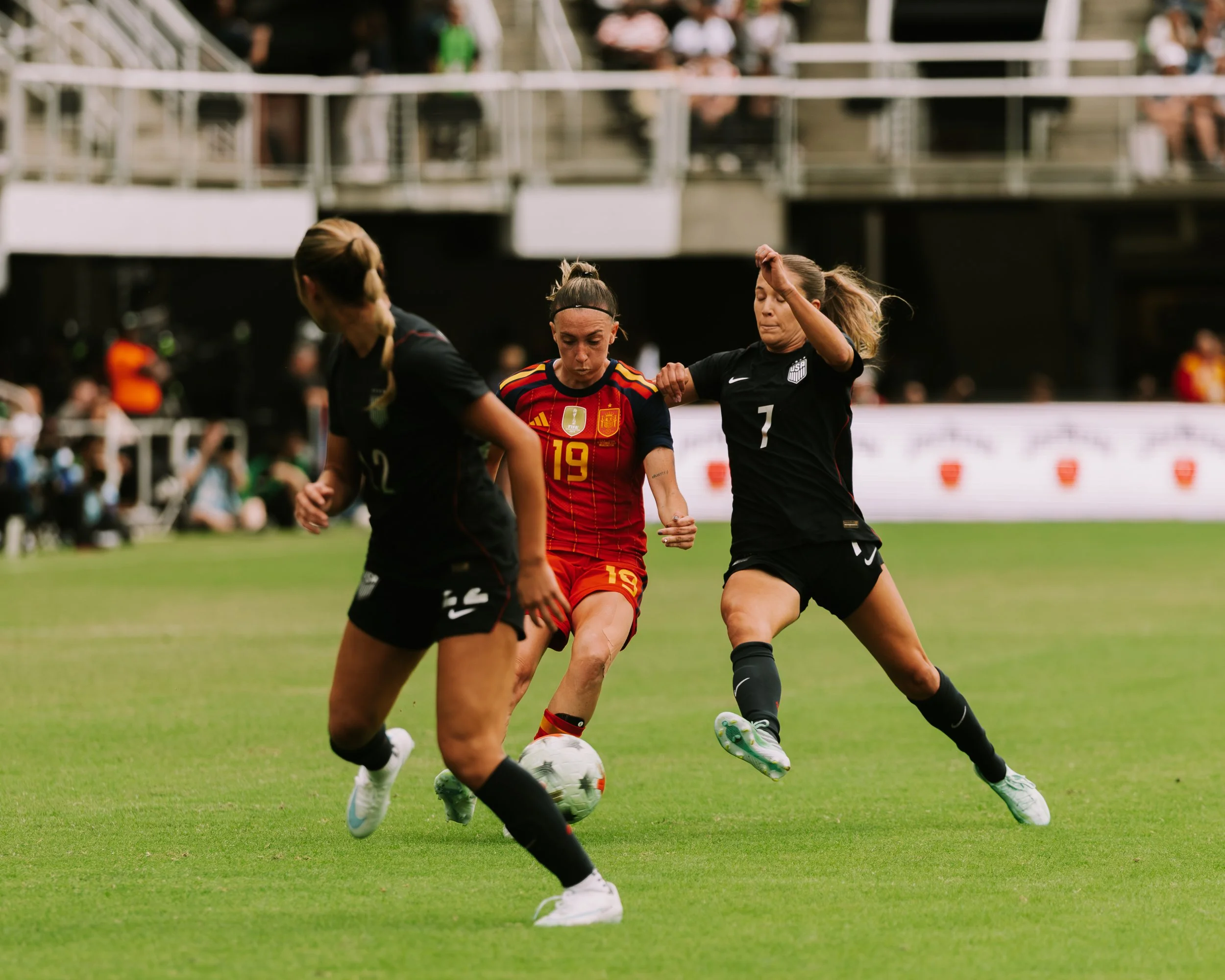
WASHINGTON, D.C. — October 10, 2026
Fourteen minutes. That’s how long it took Spain to remind the United States what competing against the world’s best actually demands. By the time Eva Navarro doubled Spain’s advantage in the 14th minute, the reigning Olympic champions were staring at a two-goal deficit in front of a sold-out Audi Field. Patri Guijarro had already opened the scoring with a spectacular strike from distance in the third minute, and the world’s top-ranked team looked every bit the defending world champion.
For the United States, it was a nightmare opening to one of its most anticipated international matchups of the year. But with the 2027 Women’s World Cup in Brazil less than a year away, perhaps this was precisely the kind of uncomfortable afternoon Emma Hayes needed her team to experience. The Americans weren’t simply facing another international opponent. They were confronting the standard they will ultimately need to meet if they intend to reclaim the World Cup.
Following the match, Hayes offered an explanation for why these encounters matter beyond the scoreboard. “You can work through all the details at this level. You have to experience it,” she said. It was an acknowledgment that even the most meticulous preparation cannot replicate the demands of facing the world’s best. Some lessons can only be learned when the opposition is good enough to punish every mistake.
A Lesson in the Smallest Margins
Spain didn’t overwhelm the Americans with an endless barrage of opportunities. Instead, it demonstrated something arguably more dangerous: an extraordinary ability to punish mistakes. Guijarro’s opening goal came after the American defense afforded the Barcelona midfielder too much space outside the penalty area. Navarro’s second exposed a breakdown in defensive positioning, leaving the Spanish attacker free to finish at the back post. Within 14 minutes, Spain had converted two chances into a commanding advantage against a team that rarely finds itself chasing the scoreboard so early.
What followed was a demonstration of the tactical sophistication that has made Spain the benchmark in international women’s football. Its movement, positional awareness, and ability to operate under pressure repeatedly disrupted the American midfield. Spanish players moved in coordinated patterns, creating passing triangles and numerical advantages that made winning possession difficult and retaining it even harder. The United States, meanwhile, struggled to establish the sustained sequences necessary to dictate the tempo of the match.
Yet the final statistics revealed a considerably more complicated story than the scoreboard suggested. According to match data from the Bet on Her app, the United States finished with 13 shots compared to Spain’s six, including 10 shots on target against just three for the visitors. Spain goalkeeper Adriana Nanclares recorded nine saves, repeatedly denying an American attack that created enough opportunities to make the afternoon far more competitive.
Sophia Wilson struck the crossbar in the first half and repeatedly threatened Spain’s defense, while Alyssa Thompson found success exploiting space along the right flank. After halftime, Wilson briefly appeared to have pulled a goal back before VAR ruled her offside. The most consequential missed opportunity arrived in the 69th minute, when 19-year-old Lily Yohannes stepped up to take a penalty in front of a hometown crowd, only for Nanclares to deny her.
Hayes didn’t attempt to disguise the difference between the two sides. “They’re efficient. We weren’t,” she said afterward, a succinct assessment of an afternoon in which the Americans created more opportunities but failed to convert a single one.
Emma Hayes Is Looking for Answers, Not Comfortable Results
There’s a reason the United States has spent 2026 challenging itself against opponents like Japan, Brazil, and Spain. Hayes isn’t preparing her team to accumulate comfortable victories against overmatched competition. She’s preparing it to navigate the tactical complexity of a World Cup, where the difference between advancing and going home can be a single defensive lapse or missed opportunity.
Against Spain, those vulnerabilities were impossible to ignore. The Americans struggled to retain possession against an aggressive counterpress, their defensive organization faltered when Spain overloaded certain areas of the field, and despite generating significantly more scoring opportunities, they lacked the clinical finishing that separates contenders from champions.
Hayes acknowledged that the American back four were playing together for the first time, but she was unwilling to use unfamiliarity as an excuse. Her assessment was particularly direct: “I don’t think it’s a case of bad luck. I think it’s bad decision, bad execution from us.” At the highest level, she explained, defensive positioning and collective movement cannot be treated as minor details. The difference of four or five yards can determine whether an opponent creates a scoring opportunity or loses possession.
The second half offered evidence that the United States could adapt. The Americans improved their attacking rhythm, generated sustained pressure, and forced Spain into a considerably more defensive posture. Spain failed to register a single shot attempt after halftime, while the United States continued creating opportunities through Wilson, Rodman, and its substitutes.
The introductions of Mallory Swanson, Ashley Sanchez, and Claire Hutton brought additional energy to the American attack, while Giselle Thompson’s arrival at halftime provided another attacking dimension from the left. But despite the adjustments, the scoreboard remained unchanged. Even with Spain reduced to 10 players following Atenea del Castillo’s stoppage-time dismissal, the Americans couldn’t find a breakthrough.
It was a frustrating conclusion to a match that offered glimpses of both the team’s potential and its limitations. The United States demonstrated it could respond tactically, but it also discovered that controlling stretches of a match means little without the execution necessary to turn opportunities into goals.
The Bigger Picture Is Brazil
The United States enters this World Cup cycle carrying an unusual combination of expectations. The 2024 Olympic gold medal restored confidence in a program that had endured a disappointing 2023 World Cup, and Hayes demonstrated that she could build a team capable of winning on the international stage. But the World Cup represents a different challenge, one that demands consistency, adaptability, and the ability to navigate elite opposition across an entire tournament.
Spain represents the evolution of women’s international football. Technically sophisticated, tactically disciplined, and increasingly capable of dictating matches against opponents that once dominated the sport, the Spanish national team has established a standard that the Americans can no longer afford to overlook. The United States still possesses extraordinary individual talent, but Saturday’s match reinforced the reality that talent alone doesn’t guarantee cohesion, and cohesion doesn’t develop without adversity.
Yet Hayes doesn’t believe the distance between these teams is nearly as significant as it once was. Reflecting on their respective trajectories, she offered a revealing assessment: “I think about the gap between Spain and us three or four years ago and I do think that gap is closed.”
It’s a striking statement following a two-goal defeat, but one that reflects the confidence Hayes maintains in her squad. She isn’t approaching Spain as an opponent the Americans might someday be capable of defeating. She believes they already possess the talent to win, even if Saturday demonstrated how much work remains in translating that potential into results.
“I expect everything from us and I think we’re good enough to beat Spain,” Hayes said.
That conviction is important because the United States doesn’t necessarily need to reinvent itself to compete at the highest level. It needs to become more consistent in the moments that matter. Hayes now has tangible evidence of what needs improvement, from defensive positioning and midfield connectivity to the final touch in front of goal. These aren’t theoretical concerns discussed during training sessions. They’re lessons delivered by the reigning world champions in a competitive environment, against the kind of opposition the United States will need to overcome in Brazil.
Sometimes the Most Important Result Isn’t a Victory
There will undoubtedly be frustration surrounding Saturday’s result, particularly given how many opportunities the United States created. A converted penalty, a more clinical finish, or a more disciplined opening 15 minutes could have fundamentally altered the match. But international football at its highest level rarely rewards hypotheticals. Spain converted its chances, defended its advantage, and left Washington with a deserved victory.
For the Americans, the challenge now is determining what they do with the experience. The second-half response demonstrated resilience and tactical flexibility, but it also reinforced how unforgiving the margins can be against the world’s best. With the two teams scheduled to meet again Tuesday in Pennsylvania, Hayes has an immediate opportunity to evaluate whether Saturday’s lessons translate into meaningful adjustments.
The United States doesn’t need to panic over a single defeat, nor should it dismiss the result as an inconsequential friendly. The objective isn’t to arrive in Brazil having won every match along the way. It’s to arrive with a team capable of solving problems, adapting under pressure, and delivering when the opportunities matter most.
Saturday’s loss provided a reminder that the distance between Olympic champions and world champions can be measured in moments rather than miles. The United States may not have gotten the result it wanted at Audi Field, but it left with something that could prove considerably more valuable over the next several months: a clearer understanding of what it will take to become world champions again.