CHESTER, PENNSYLVANIA — October 13, 2026
For the second time in four days, the USWNT found itself staring at a two-goal deficit against the best team in the world. Different stadium, different lineup, same familiar nightmare. Spain had once again exposed the defensive vulnerabilities that plagued the USWNT in Washington, and by halftime at Subaru Park, the reigning Olympic champions were facing the possibility of consecutive defeats to the team they may eventually need to overcome to win the 2027 Women’s World Cup.
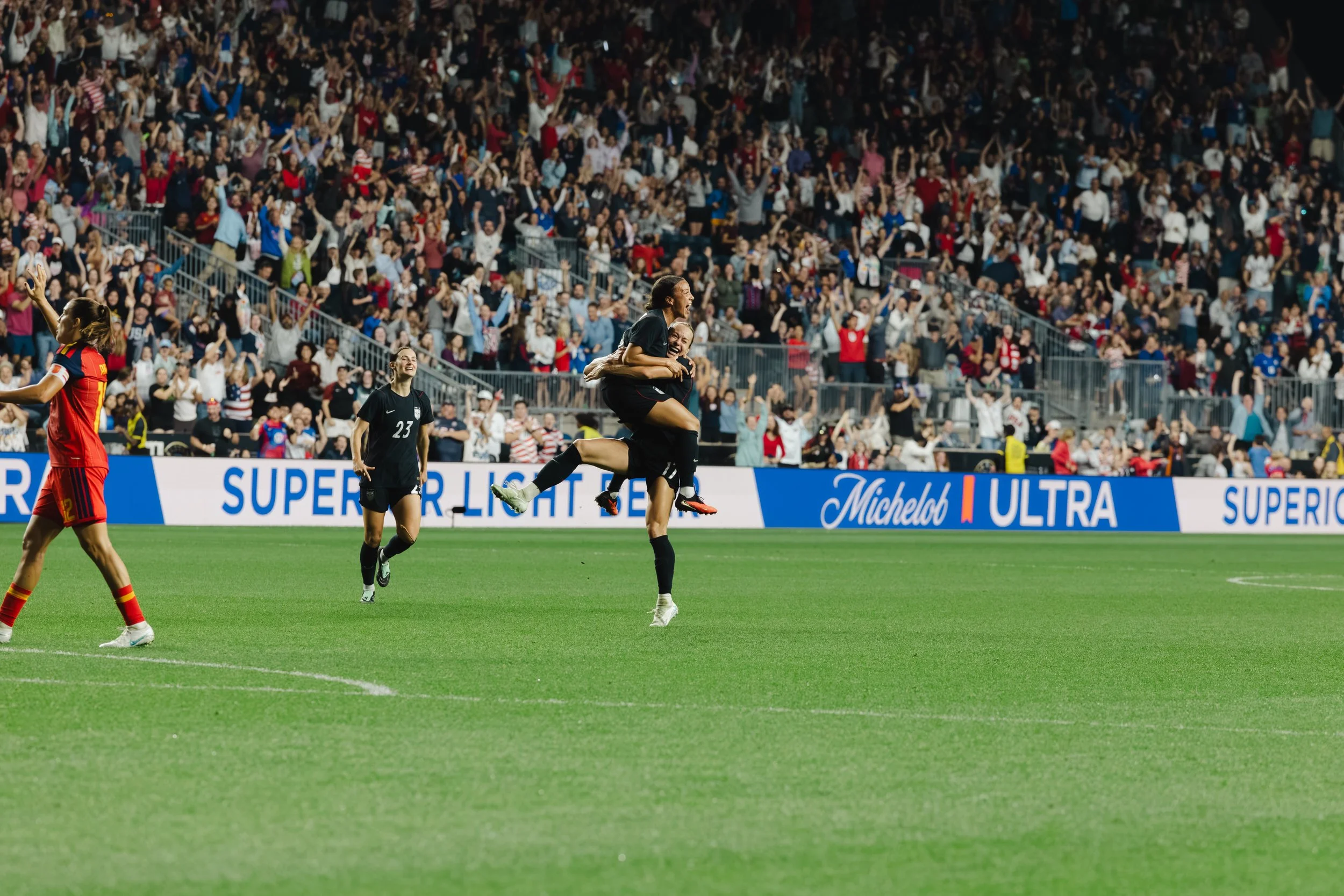
But something changed after the break. What had threatened to become another painful lesson in Spain’s superiority instead became a demonstration of the resilience that has defined some of the greatest teams in USWNT history. Ashley Sanchez pulled one back just four minutes into the second half, and Mallory Swanson completed the comeback in the 86th minute with a stunning finish that sent the crowd of 18,648 into celebration. The final score was 2–2, but the significance of the result extended well beyond a draw.
For a team still searching for consistency under Emma Hayes, Tuesday night offered something that Saturday’s defeat could not: proof that the USWNT could absorb a devastating blow from the world’s best and find a way to fight back.
Déjà Vu, and Another Punch in the Face
The opening 25 minutes suggested the USWNT had learned from its mistakes in Washington. Hayes’ side looked more composed in possession, more organized defensively, and considerably more disciplined in its pressing. The gaps between the defensive, midfield, and attacking lines were tighter, limiting the spaces Spain had exploited so effectively just days earlier. Sophia Wilson was again finding opportunities behind the Spanish defense, while Ashley Sanchez, making her first national team start in nearly two years, brought a renewed attacking presence on the left.
Then Spain reminded everyone why it holds the world’s No. 1 ranking.
In the 27th minute, Alexia Putellas marked her 150th international appearance by finishing a beautifully constructed Spanish attack at the back post. Five minutes later, Salma Paralluelo doubled the advantage after a misplaced clearance from goalkeeper Phallon Tullis-Joyce allowed Spain to transition quickly into attack. Paralluelo’s finish was spectacular, curling into the upper corner and leaving the USWNT goalkeeper with little chance of recovery.
It was an almost cruel repetition of Saturday’s match. The USWNT had shown improvement, created opportunities, and demonstrated greater tactical awareness, yet Spain had once again punished two moments of defensive vulnerability with ruthless efficiency. Across the two matches, the USWNT had now conceded four goals, all in the first half, while struggling to translate its own attacking opportunities into results.
At halftime, the concern wasn’t simply that the USWNT was losing again. It was that the team appeared to be learning the same lesson without finding a way to change the outcome.
Ashley Sanchez Changes the Conversation
Four minutes into the second half, Ashley Sanchez gave the USWNT something it desperately needed: a reason to believe.
The opportunity began with Sophia Wilson turning away from pressure and advancing into the attacking third. When the ball reached Sanchez on the left, she created just enough separation from the Spanish defense to open a shooting lane. Her finish was precise, finding the far corner beyond goalkeeper Misa Rodríguez and cutting Spain’s advantage in half.
For Sanchez, the moment carried significance beyond the scoreline. After nearly two years away from the national team, she returned following a remarkable NWSL campaign with the North Carolina Courage, scoring 20 goals and reestablishing herself as one of the league’s most dangerous attacking players. Her return to the starting lineup was already a story of perseverance. Scoring against the reigning world champions made it something more.
The goal also changed the energy of the match. Hayes had adjusted the USWNT into a 3-5-2 formation at halftime, attempting to match Spain’s numbers in midfield and create additional support when defending against overloads. The adjustment carried risks, but it reflected a willingness to experiment against elite opposition rather than simply protect against further damage.
Suddenly, the USWNT was no longer chasing a consolation goal. It was chasing the match.
The Depth That Could Define This Team
If Sanchez provided the spark, the USWNT bench supplied the fuel.
Hayes made five substitutions shortly after the hour mark, introducing Mallory Swanson, Lily Yohannes, Michelle Cooper, Alyssa Thompson, and Jaelin Howell. The changes brought fresh legs, greater physicality, and a noticeable increase in attacking urgency. Spain, which had controlled so much of the first half through its technical precision and positional discipline, increasingly found itself defending against a USWNT side unwilling to accept another defeat.
The numbers reflected the competitive nature of the contest. According to match data from the Bet on Her app, both teams finished with 15 shots, while the USWNT held a 6–4 advantage in shots on goal. Spain maintained 58.1% possession and completed 475 accurate passes compared to 325 for the USWNT, but Hayes’ side generated eight corners to Spain’s five and continued creating pressure as the match entered its final stages.
What stood out wasn’t simply the number of opportunities. It was the variety of players contributing to them. Sanchez had already delivered the breakthrough, Yohannes was finding dangerous passes between Spain’s defensive lines, and Cooper’s physicality and willingness to challenge defenders gave the USWNT another attacking dimension.
Then, in the 86th minute, everything came together.
A long ball from substitute Kate Del Fava released Cooper into space behind the Spanish defense. Although Cooper couldn’t initially get the ball out from under her feet, she maintained possession and worked it back toward Swanson. The returning forward needed only one opportunity, striking a brilliant volley into the side netting to complete the comeback.
It was Swanson’s first international goal since the gold medal match at the 2024 Paris Olympics, and a remarkable moment for a player returning to the national team after becoming a mother. Her appearance against Spain on Saturday had marked her first USWNT match since October 2024. Four days later, she was delivering the equalizer against the world’s top-ranked team.
There was something particularly fitting about the two goalscorers. Sanchez and Swanson had both returned to the national team after lengthy absences, and both had been asked to prove they could contribute at the highest level. Against Spain, they provided the answer.
Awakening the Sleeping Dragon
The USWNT could have settled for the draw. After all, recovering from two goals down against the reigning world champions was already an accomplishment. But what happened after Swanson’s equalizer may have been the most revealing stretch of the entire match.
Rather than retreating to protect the result, the USWNT continued attacking. Alyssa Thompson challenged defenders on the left, Cooper remained dangerous on the right, and Yohannes nearly delivered a remarkable stoppage-time winner. Her late effort took a deflection and forced Rodríguez into an extraordinary reaction save, preserving the draw and denying the USWNT what would have been an unforgettable victory.
It was a fitting conclusion to a match that had transformed from potential disaster into something approaching redemption. The USWNT hadn’t suddenly solved every tactical problem exposed across these two encounters. Spain remained the more accomplished team in possession, and the defensive mistakes that produced four goals over two matches will demand serious attention before World Cup qualifying. But the second half demonstrated a quality that cannot always be measured through passing percentages or possession statistics.
The USWNT still knows how to fight.
There is a reason Hayes has deliberately scheduled opponents like Japan, Brazil, and Spain during this World Cup cycle. She understands that the path to becoming world champions requires more than collecting victories against comfortable opposition. It requires confronting adversity, discovering weaknesses, and developing the collective belief necessary to respond when a match begins slipping away.
Tuesday night provided that experience in its most dramatic form. The USWNT was outplayed in decisive moments, punished for mistakes, and pushed to the brink of another defeat. But unlike Saturday, it found a way back, with contributions from returning veterans, emerging talent, and a bench that demonstrated the extraordinary depth available to Hayes.
A Different Kind of Victory
The USWNT leaves this international window without a victory over Spain. A 2–0 defeat in Washington followed by a 2–2 draw in Pennsylvania is hardly the kind of record that would ordinarily inspire celebration. But the progression between those results tells a more meaningful story about where this team stands and what it might become.
Saturday exposed the distance between potential and execution. Tuesday revealed that the USWNT possesses the resilience to close that distance, even when the circumstances appear overwhelming. There are still questions surrounding defensive organization, goalkeeper distribution, and the ability to sustain possession against technically superior opposition. Those concerns haven’t disappeared because of one remarkable comeback, and Hayes would be the first to acknowledge that the work is far from finished.
Yet there is something unmistakably encouraging about a team that refuses to surrender against the world’s best. With World Cup qualifying approaching and Brazil 2027 on the horizon, the USWNT will need more than tactical discipline and individual brilliance. It will need the confidence to respond when things go wrong, the depth to change matches from the bench, and the collective determination to keep fighting when the odds turn against it.
For 135 minutes across two matches, Spain had repeatedly reminded the USWNT how far it still had to go. But in the final 45 minutes at Subaru Park, the USWNT offered a reminder of its own.
The sleeping dragon isn’t fully awake. But Spain may have just reminded it how to roar.